


Working software every two weeks


Agile Software Development Services
Agile is not a set of ceremonies. It is the decision to build in small increments, show them to real users, and change direction while changing direction is still cheap.
Quanrio delivers software that way — a working, deployable increment at the end of every sprint, demonstrated rather than reported.
You get visibility into progress from the first month and the ability to reprioritise without renegotiating a contract.





Our Work





What our clients say
Baqar Jafri
CEO, Investors Lounge
Investor Lounge needed a tool that could gather news articles of different genres from multiple sources, Quanrio was unbelievably helpful in accomplishing this task for us. They came up with a well researched tool and provided customized solution according to our needs. Most prominent quality of Quanrio is their honest...


Fahad Javed
HR Manager, House of Habib
Quanrio designed a system that has automated HR processes at HoH earlier acheived with papers going through several desks. The software they provided to House of Habib was built around the company policies and fits in perfectly. This required not only technical knowledge but their ability to communicate and understand...


Uzma Shah
HR Manager, Engro Systems
Consultancy provided by Quanrio in automating processes is unmatched! Team is highly patient, collaborative and knows how to successfully pull off difficult and unique tasks, enabling them to provide tailored solution for every unique problem. Communication and availability is one of their valuable traits; They are swi...


Michel Combes
Co-Founder, AdoLE
I recommend Quanrio for its exceptional services in mobile application development. I recently entrusted Quanrio with a time-sensitive project to develop an ultra-fast mobile application for a conference demonstration. I'm thrilled to share that their team not only met but exceeded all my expectations. Despite the chal...


Simone Zacho Baarts
Head of Operations, Raw Research
Partnering with Quanrio has been an exceptional experience. Despite the geographical distance—me in Denmark and Quanrio elsewhere—the team remained consistently accessible whenever I required their assistance. Quanrio's work is nothing short of remarkable; the quality they deliver is truly commendable. Their patience i...

The Point Is Reversible Decisions, Not Standups
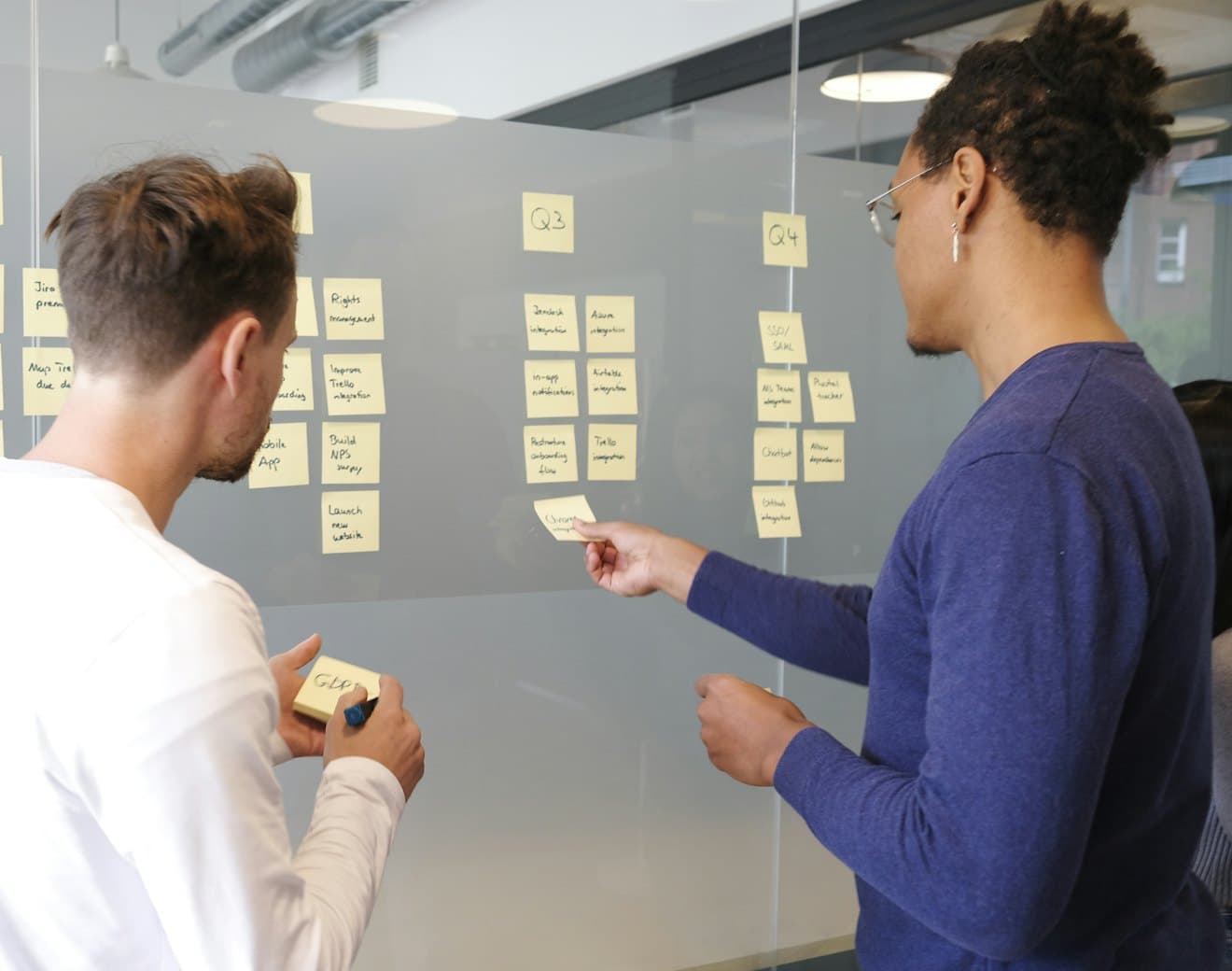
Plenty of teams run every ceremony in the book and are no more agile for it, because the plan is still fixed and the first working software appears in month nine. The value of agile is entirely in shortening the gap between a decision and the evidence that it was right or wrong.
So we optimise for that: a deployable increment every sprint, real users in front of it early, and a backlog that gets reordered based on what we learn rather than defended because it was signed.
What Agile Delivery Changes For A Client
You See It Working Early
A demonstrable increment at the end of every sprint, deployed where you can use it yourself. Progress is judged by software rather than by a percentage in a status report.
Change Costs Less
Reprioritising the next sprint is a conversation, not a change request. Requirements move on almost every project, and the process should expect that rather than penalise it.
Risk Surfaces Sooner
Hard problems are tackled in the first sprints rather than saved for later, so the unpleasant surprises arrive when there is still time and budget to deal with them.
Quality Is Continuous
Testing, review and deployment happen every sprint, so there is no integration phase at the end where a project quietly loses two months.
Budget Under Control
Because value ships continuously, you can stop, pause or redirect at any sprint boundary and still have working software rather than a half-finished build.
Your Team Learns Too
We work in your repositories with your engineers involved, so practice and knowledge stay with you rather than leaving when the engagement does.
Solutions We Deliver
How We Deliver Agile Engagements
Discovery And Backlog Shaping
A short engagement that turns an idea into a prioritised backlog with an architecture, an estimate and named risks — enough to start without pretending to know everything.
Scrum Delivery Teams
A cross-functional team on two-week sprints with planning, review and retrospective, delivering a deployable increment every cycle.
Kanban For Continuous Work
Flow-based delivery with work-in-progress limits for support, maintenance and streams where a fixed sprint boundary adds nothing.
DevOps And Continuous Delivery
Pipelines, environments, automated testing and staged deployment, because an increment that cannot be released is not really done.
Agile Coaching
Working alongside your team to improve practice — estimation, backlog refinement, definition of done — rather than delivering a training day and leaving.


The Practices That Make Agile Actually Work
A Real Definition Of Done
Written, tested, reviewed, documented and deployed to staging. Anything less accumulates into an invisible backlog that surfaces as a delay near the end.
Automated Testing And CI
A suite fast enough to run before every push, so refactoring stays safe and the team keeps its speed in month nine as well as month one.
Trunk-Based Development
Short-lived branches and feature flags rather than long-running branches, so integration happens continuously instead of as a painful event.
Observability
Logging, metrics and tracing from the first sprint, so behaviour in production is something you can see rather than something you reconstruct after an incident.
Visible Progress
A board you can open at any time, written standups and honest burndown. You should never have to ask how it is going or be surprised at a sprint review.
Run A Project With The Practices That Keep It Honest
1
Demo Over Report
Every sprint ends with working software you can use, not a slide saying seventy percent complete. It is the only progress measure that cannot be fudged, and it changes the conversation entirely.
How We Run The Build
Step # 1
Discovery And Planning
We start by understanding the problem rather than the feature list: who the users are, what they are trying to finish, and what the business needs out of it.
That turns into a scoped plan — the functionality, the technical requirements, the milestones, the budget and the timeline — before anyone opens an editor.
Step # 2
UI/UX Design
Wireframes first, so the structure is agreed while it is still cheap to change, then the visual design built on your brand.
We prototype the journeys that matter and put them in front of people early, so the interface is tested rather than assumed.
Step # 3
Development
Development runs in short increments you can see. Frontend and backend are built together against a shared contract, so integration is not left as a surprise at the end.
Code is reviewed, environments are scripted, and every increment ships to a staging build you can open yourself.
Step # 4
Quality Assurance
QA runs throughout the build, not as a phase bolted on before launch — functional testing, cross-device and cross-browser checks, performance, and security review.
Bugs are fixed against the increment that introduced them, so the release does not inherit a backlog.

Step # 5
Launch And Support
We handle the deployment, the store or server configuration, and the monitoring that tells us how the release is behaving in the real world.
After launch we stay on it: fixes, improvements, and keeping the stack current so it does not quietly rot.

Why Teams Choose Quanrio For Agile Software Development
Affordable pricingPremium quality assuranceProfessional custom mobile app developersCustomized solutionsOn time delivery
User centric designContinues supportClient satisfactionDirect contact with your team
Frequently Asked Questions
What Is Agile Software Development?
Agile Software Development is a software development approach used to develop complex software by breaking down the entire software development in broken down into small, manageable increments called iterations or sprints. The agile approach relies more on team collaboration and user feedback.
What is an Agile software development company?
An Agile software development company is a software development company that creates software and applications using the Agile development approach. This approach allows them to create robust and client-focused agile software solutions by making fewer mistakes and mitigating risks. We are also an agile software development company in USA with more than a decade of experience.
What do developers do in Agile?
The software developed using the Agile software development approach is created by developers who work closely with other team members. Developers in Agile write code to implement features and functionalities. Additionally, they work in short iterations or sprints, continuously refactoring their code to improve its design, readability, and maintainability.
What are some benefits of the Agile development methodology?
Agile's greatest benefit is its flexibility, ideal for projects with uncertain or changing requirements. The team completes a step, tests it with users, and repeats the process. Agile also adapts quickly to changes in customer behavior, industry standards, or technology, making it a cost-effective choice for limited b