



Mobile application development services in the U.S. has always been about staying relevant in the economy.
Here’s why: since 2010, people have increasingly used their smartphones to access the internet. Big Corps noticed this before anyone else and went mobile.
So in a nutshell, people went mobile first, causing businesses to go mobile-first. That’s how mobile apps in the US went from being a supporting channel to the main stage of digital business.
In this guide, we’ll cover:
- Why mobile apps dominate the US Digital Landscape.
- Why (and how) people in the US went mobile-first.
- Why Big Corps in the US went mobile-first (timeline included).
- How the US mobile app market changed after COVID.
- U.S. app market’s revenue from 2023 to 2025.
- US market stats today and projections for the future.
- Key segments, popular apps in the US, opportunities, and challenges.
- What mobile app development really means in 2025.
- Traditional VS modern-day development approach.
- Modern-day development approach and its implications for the US startups.
- The startup factor, including why the U.S. investors are interested in mobile-first businesses.
- For U.S. startups, which KPIs drive startup valuations?
Why Mobile Apps Dominate the US Digital Landscape
Every major digital shift in history follows one rule: Go where people’s attention moves.
Over the last decade, that attention has migrated almost entirely to mobile.
Let’s take the Mobile Access 2010 report by Pew Research as an example. In that finding, Aaron Smith reported 40% of adults use a mobile device to access the internet, which was an 8% increase from 32% in 2009.
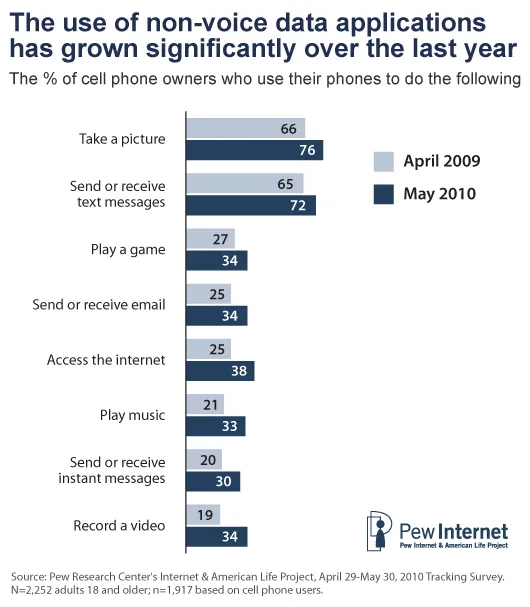
Credit: Mobile Access 2010 by Pew Research
Just 2 years later, in April 2012, out of all U.S. adults who owned a cell phone (88% of the total population btw), 55% were already using it to go online.
This lil gem was also dropped by Aaron Smith from Pew Research btw.
Not to anyone’s surprise, when people were asked why they were conducting most of their online browsing on a mobile phone, they simply responded with 3 reasons
- “Cell phones are handy.” Said 64% of cell internet users.
- “Cell phone fits my needs better than a computer”. Said 18%.
- “It fills the access gap”. Said 10% of the respondents didn’t have a computer.
Reports like this basically screamed, “The mobile-first era is here.” And the tech giants heard this scream better than anybody else.
In the same year, 2012, the Google Play Store was born. The next thing you know, publishers pushed more than 2 million more apps and games on the store, reaching 3.6 million apps in total in 2017 on Google Play Store, and 25 BILLION downloads occurred in 2012 from Apple’s App Store.
That’s how quickly the mobile-first era became a reality. It was like a wildfire that took over.
The Rise Of Mobile-First Businesses In The US
So far, we've understood the main reason that triggered businesses to go mobile first.
A quick recap of how consumer behavior led business transformation: It was because people were increasingly using mobile phones to connect to the internet, and companies were observing an incremental change in mobile-first traffic, and the reason why people were increasingly using mobile phones to access the internet, as reported in the research we've cited in the blog, was simple: Mobile phones are handy and more personalized to our needs.
(Now tell me how that's changed, lol. Phones are still handy and more personalized.)
Bottom line: Consumer behavior always leads the way. Businesses follow where people move.
So when people went mobile, businesses did too.
And that’s what set the stage for the rise of mobile-first businesses in the U.S.
The result? 62% (nearly two-thirds) of the Fortune 100 companies already had some publicly available mobile app, whereas 52% had a mobile-specific website, which you didn’t have to constantly scroll, zoom, pinch, and so on.
Timeline Of Big Corporations In The U.S. Going Mobile-First (Since 2014)
In 2014, Marissa Mayer (then CEO of Yahoo) said, “We’re in the midst of a massive and continuing platform shift to mobile and something that’s central to our forward progress at Yahoo,”, and that simply meant that all of Yahoo’s new products were to be designed for the mobile-first experience
The same year, 2014, Satya Nadella, CEO of Microsoft, said in his initial remarks that Microsoft is now embracing, in what he called “the new “mobile-first cloud-first” world,”.
The same year, Facebook officially became a mobile-first company
In 2015, Google reported that more Google searches happen on mobile devices than on computers.
Again in 2015, The New York Times’ Chief Information Officer reported that mobile was only 30% of the traffic across all their products and devices, meaning in 2014. It topped 50% in 2015. He also projected that in as little as 2 - 3 years from now, mobile may amount to as much as 75% of the traffic and become the most dominant platform. This clearly signalled that the Times was becoming a mobile-first publisher.
In November 2016, Google announced that it would experiment with a mobile-first index for search; it went as far as to say that its algorithm would primarily use the mobile version of a site to rank pages. This was basically just build/following up on its 2015 finding that more Google searches are happening on mobile devices than anywhere else.
In 2017, Wells Fargo launched Greenhouse, a digital-only, mobile-first bank brand.
Accenture’s CIO Andrew Wilson told The Enterprisers Project that he was working to make the global consulting firm a mobile‑first organisation.
At Microsoft Inspire 2017, Samsung Electronics America showcased partner solutions that foster a channel ecosystem focused on mobile‑first strategies.
In a 2018 interview on Button’s mobile‑commerce blog, Susanne Greenfield (VP of global strategy) said that mobile is a critical part of Booking Holdings’ long‑term strategy and that the company strives to think as a “mobile first” company.
In the same year, in a Forbes interview about the Fintech Bank’s U.S. launch, N26’s Americas CO Nicolas Kopp said that “N26 is a European mobile-first bank.”
In its 2019 10‑K filing, T‑Mobile reported that in April 2019 it launched T‑Mobile MONEY, a mobile‑first checking account that can be opened and managed entirely from a customer’s smartphone.
The same year, Celent analyst Zilvinas Bareisis wrote that Apple’s newly announced Apple Card is the first credit card issued first and foremost into a mobile device, describing it as a mobile‑first credit card, and that a companion physical card was merely an add‑on.
Then Covid happened…
And it all went online, and mobile-first
In 2020, the company accelerated plans for Starbucks Pickup stores designed for customers ordering ahead via the Starbucks app.
In November 2020, McDonald’s announced its “Accelerating the Arches” strategy and said it would “double down on the 3 D’s: Digital, Delivery, and Drive‑thru.” A new digital experience platform called “MyMcDonald’s” would unify ordering, payment, and loyalty in the app and allow personalised offers
Walmart’s chief product officer explained that during the pandemic, the retailer merged its grocery and general merchandise apps into a single “super app.”
During 2021 - 2022, Multiple restaurant brands emphasised mobile ordering and contact‑free pickup/delivery during the pandemic. McDonald’s (above) highlighted its MyMcDonald’s app. Domino’s, Chick‑fil‑A, and Chipotle introduced or expanded order‑ahead and curbside pickup through their apps.
Many retailers complemented e‑commerce websites with mobile shopping and scan‑and‑go features. For example, grocery chains like Kroger and Whole Foods expanded curbside pickup and in‑app ordering, while discount retailers such as Target offered Drive Up and Order Pickup in their mobile apps.
In 2023, the U.S. app market generated $44.9 Billion.
In 2024, the mobile app market was worth $522.67 Billion.
In 2025, app spending is forecasted to reach $270 Billion in 2025.
As people shifted to mobile, businesses across industries followed, transforming their products, websites, and strategies to prioritize mobile experiences from 2012 onward, which caused the rise of mobile-first companies across the U.S.
US market stats and future projections
The United States mobile application market size is USD 80.92 Billion as of 2025 (Mordor Intelligence United States Mobile Application Market Size & Share Analysis report). While Mordor Intelligence projects the growth rate (2025 - 2030) to be 11.83%, Grand View Research reports CAGR to be 14.1% for the same period (2025 - 2030).
According to GVR, the U.S. market is growing fast, and it’s not hard to see why. There are tons of mobile app development companies popping up, and businesses are leaning on apps more than ever to connect with customers and grow their reach.
Key Segments:
|
Popular apps:
|
Opportunities:
|
Challenges:
|
Don't forget to checkout: 8 Best Software For iOS App Development For Building Professional Apps
What “mobile app development” really means in 2025
This section covers:
- A quick overview of the traditional vs modern-day transformation
- What modern-day mobile app development looks like
- The implications for the startup owners in the US.
| Traditional | Modern-Day |
|
Historically, mobile apps were built natively for each operating system. Companies had to create separate codebases (Objective‑C/Swift for iOS and Java/Kotlin for Android) and maintain separate teams. Lean startups that tried to take the hybrid route found out that its simplicity fell apart as the app grew in complexity, so did the incurring cost, and they had to move back to native. |
Today, Modern toolkits such as Flutter and React Native let developers build one app that runs on both iOS and Android. |
Hybrid frameworks were time-saving but had limitations. Cordova/PhoneGap allowed developers to wrap web code in a native shell, and early-stage startups used them to accelerate development. However, hybrid apps struggle with performance due to limited hardware access, and UX is non-customizable. |
|
|
Traditional apps were often tied to on‑premise servers and monolithic architectures. In a 2018 Diginomica report on the New York Times, engineering director Deep Kapadia explained the following: The problem with that was when the usage scaled during major events. That’s when the organization found that managing its own infrastructure limits the ability to build and deploy apps quickly. So this monolithic model clearly lacked automation and continuous delivery. |
Organisations are replacing monolithic apps with microservices deployed on cloud platforms. In the Reddit thread linked above, the user Ab_initio_416 perfectly explains why monoliths were replaced with microservices. He said, “One change could require rebuilding and redeploying the whole app A single crash could bring down the entire system Large teams stepped on each other’s toes — hard to work in parallel Scaling was all-or-nothing — you couldn’t just scale the part getting hammered (like payments or search) So came microservices”… |
Implications For The US Startup Owners Trying To Get Mobile Apps For Their Businesses
- Faster MVPs and lower initial costs: Cross‑platform frameworks allow startups to launch on iOS and Android with a single development effort.
- Scalability and operational efficiency: Building apps with a cloud‑native micro‑services architecture positions startups for scale.
- Competitive pressure requires agility: With the mobile app market being worth $522.67 Billion, speed and differentiation are critical.
- Modern tools allow startups to iterate rapidly and integrate with emerging services (e.g., AI or payment APIs).
- HOWEVER, competition also means that poor user experiences or slow updates can quickly erode market share.
- That’s exactly why US startups in 2025, when getting a mobile app for their business, should consider selecting the right development approach and investing in scalability and user experience. That’s the key to attracting both investors and customers.
The Startup Factor
Why U.S. Investors Are Interested in Mobile-First Businesses
- Companies building mobile-first platforms are getting billions of users pretty much every day.
- That’s where the appeal is for the investors in the US. This market offers them recurring revenue models. 93% of executives say app users engage more with upsells and new services, allowing for healthy margins.
- Strong potential for viral growth. In fact, 90% of executives report higher lifetime value from app users, and 49% see over $50 revenue gain per user.
For U.S. Startups: Which KPIs Drive Startup Valuations
A16z, a venture capital firm for bold entrepreneurs in the US, says that the number of downloads are in fact, a vanity metric, and investors don’t want to hear that.
Instead, here are the KPIs that mobile-first startups should focus on in the U.S.:
-
- Engagement on metrics that are central for the business, for example, Daily Active Users, Monthly Active Users, Photos shared, viewed, downloaded, etc.
- DAU/MAU Ratio: This is calculated simply by Number of DAU/Number of MAU= DAU MAU Ratio.
- Also, the target should be 20%, which is considered good, with anything above 25% being quite EXCEPTIONAL. Investors use DAU/MAU to evaluate user stickiness and predict revenue. So if your DAUs are 500 and MAUs are 5000, then stickiness is 10%.
- Session Length: This is done using timestamps (ex: 1:30 AM). So, the timestamp user closes your mobile application (1:30 AM) minus the timestamp they opened it (1:05 AM) is equal to the session length (25 minutes, in our example).
Formula: The Timestamp user closes the application - The Timestamp user opens the application = session length.
Note: The reason why ‘closes the application’ timestamp is put before the ‘opens the application’ is because the prior timestamp’s value will always be greater than the latter. Therefore, -25 session length wouldn’t mean anything… Imagine, how did anyone use your app for -25 minutes lol… I know, this one was DUH… but yea, had to include this as it’s pretty important
-
Activity Metric: The crux of it all. It’s a single metric that captures the core value delivered by the app. For a ride-hailing app, that would be the number of rides completed. Sequoia makes a very interesting point here: in addition to measuring the product-level retention, you can also measure the feature-level retention, where you’re measuring the value a certain feature is delivering to the end user. It helps you determine how practically valuable and usable a certain feature is for your end-user.
Concluding… for now…
As people moved to mobile, companies that followed early gained a decisive edge in engagement, retention, and long-term loyalty.
It’s also why investors in the U.S. are now more inclined toward mobile application businesses.
Basically, they see mobile apps as something that creates continuous value loops through usage data, user retention, and recurring engagement.
For startups and businesses, it means:
- Mobile-first is no longer optional.
- Whether you’re building an MVP or expanding an existing business, mobile is the default mode of engagement.
- Retention and engagement are the success metrics.
- Growth now depends less on downloads and more on daily, habitual usage.
- Investors in the US follow traction, hence sustainable valuations come from proven user activity.
- 2026 and beyond will favor optimization and experience.
- Continuously refine, personalize, and adapt mobile experiences for the end-users.
A quick note: I’ll continue updating this guide with newer findings, research, insights, data, and case studies as the U.S. mobile app landscape continues to change.
Don't forget to checkout: 38 Famous Web Application Examples Categorized Into 8 Types